
Professional race timing for everyone. All you need is a phone.
Recording passings by tap, QR code, NFC chip or RFID reader. Timing works offline too. Results are online the same second.
Free for up to 5 participants per event. No card required.
€0
for hardware. Just the phone you already own.
4
ways to record a passing — tap, QR, NFC, RFID.
3
start types — individual, mass, waves.
0 s
delay on results; they publish live, during the race.
Features
Four things you won't get elsewhere
A native app, not a website in a browser. That's the difference between tapping around and a real timing system.
NFC · RFID · QR
Four ways to record a passing
Manual tap, QR code, holding an NFC chip to the phone, or a professional RFID reader for larger events.
OFFLINE
Works without a signal too
In the mountains or the woods, timing keeps going. Data is stored on the phone and syncs once you're back in coverage.
LIVE RESULTS
A public event page
Online participant registration, live and final results, and splits — all on your event's own page.
STREAM
Live broadcast from the course
Embed a YouTube or Facebook stream right into the results page. Viewers see the course and the times in one place.
How it works
From setup to results in one afternoon
01
You create an event
Name, date, start type, categories and checkpoints. In the app, in a few minutes.
02
Participants sign up
On the event's public page. They get a bib number automatically or pick their own.
03
You time and publish
Every recorded passing shows up in the results. After the race, mark them final with one tap.
In the app
Set it up once, then time with one tap
The app is light for outdoor use and has no unnecessary layers — no clicking through menus on the course.
Event name
Date
Time
Start type
Recording method
Event setup
Name, date, start type and recording method. Add categories and checkpoints as needed.
Riverside Night Run
Live results
Timing on the course
Tapping a row records a time — no confirmation needed. A green flash confirms it, and the offline bar shows what's waiting to sync.
Why TAQIO
The simplicity of a stopwatch, the accuracy of a timing company
Until now you had two options: time it by hand with a stopwatch, or pay for a professional timing company. TAQIO is the third.
STOPWATCH
Cheap, but you're retyping results into a spreadsheet after the race. Mistakes, no splits, no registration.
TIMING COMPANY
Accurate, but expensive and needs booking months ahead. With 40 participants, it just doesn't pay off.
TAQIO
Set up an event in minutes, time it with a phone or an RFID reader, and results are online the same second.
In action
TAQIO at a real race
Enduro Team Devils season finale, 3 Oct 2026. A reader on a wooden post at the finish and a phone with TAQIO — nothing more. A rider passes the antenna, the reader beeps and the time is recorded. Results went straight to the web.
- riders on course
- 44
- finish-line passes
- 251
- categories
- 3
- phone for all the timing
- 1
Pricing
You pay from the sixth participant
The app is free to download with full functionality for up to 5 participants per event.
FREE
€0
forever, up to 5 participants per event
- Full app functionality, no restrictions
- Manual tap, QR, NFC and RFID
- Offline timing and sync
- Public event page with results
YEARLY
€49.99
per year — that's €4.17 a month
- Unlimited participants
- All three start types, including waves
- Splits and live results
- Embedded YouTube / Facebook stream
- 30-minute call — we'll walk you through the app and answer your questions
CUSTOM
Custom pricing
TAQIO with custom features — do you have specific needs for your timing app? Let's talk about it.
Get in touchEquipment
Recommended equipment
Hardware we use ourselves with the TAQIO app. You order it directly from the supplier.
Timing method
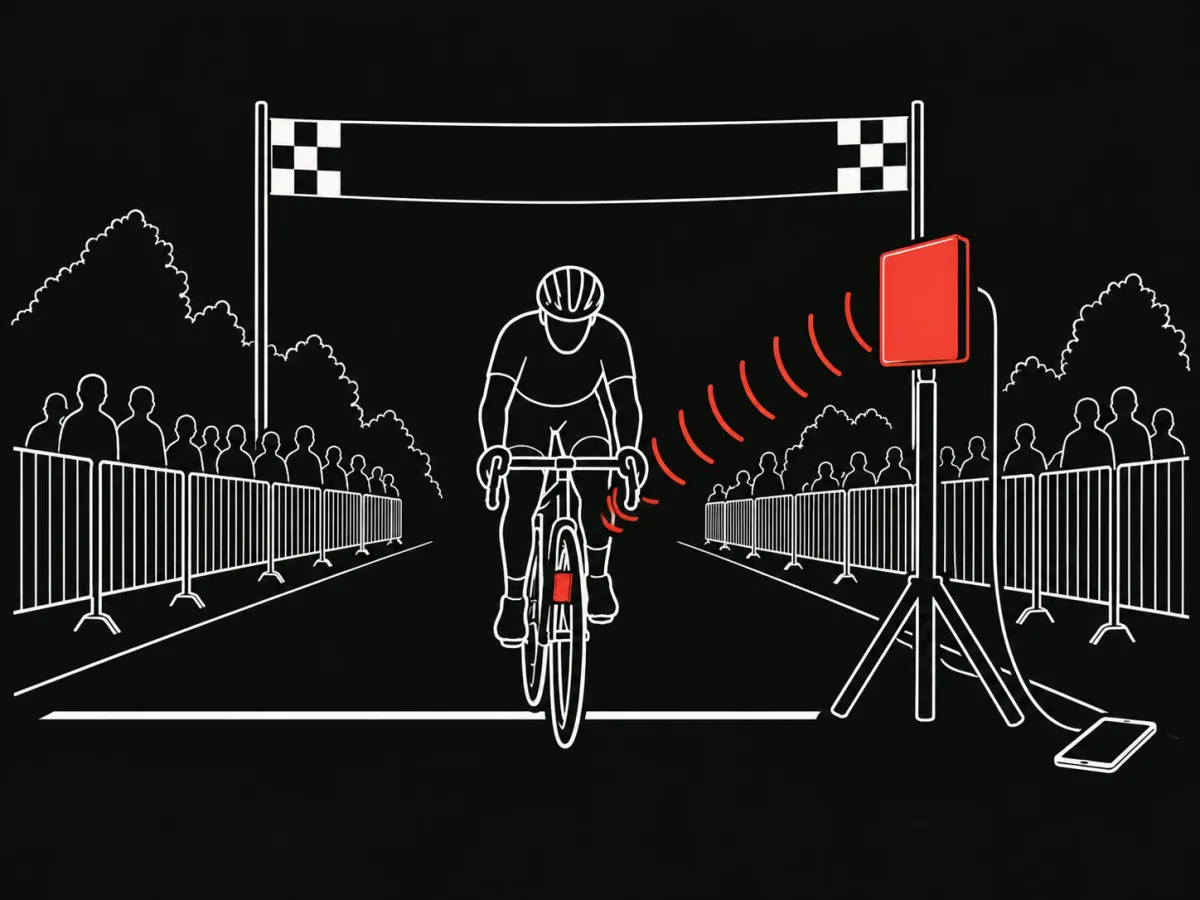
A reader with an antenna picks up chips several metres away as participants pass, without stopping.
Approximate price
UHF reader with antenna about €200; UHF sticker tags about €0.10–1 each depending on quantity.
Yanzeo SR691 UHF RFID reader
Outdoor reader with an integrated antenna for capturing chips at the finish or at a checkpoint.
- Read range up to 10 m
- IP67, operating −20 to +60 °C
- 9 dBi antenna, 12 V DC power
- EPC Gen2 (ISO 18000-6C) tags
Approximate priceabout €200
In Europe, order the 865–868 MHz band; in the US, 902–928 MHz. To connect it to a phone you also need a USB-A → USB-C (OTG) adapter — the reader cable ends in a standard USB plug.
View at supplier ↗Buy the chips from a seller in your country: ordinary UHF sticker tags with as large an antenna as possible (long and narrow, about 7–10 cm) for your band — 865–868 MHz in Europe, 902–928 MHz in the US; most stickers are "global" 860–960 MHz, which is fine. Choose durable (film, not paper) labels.
Stick them on plastic, e.g. under the helmet peak or behind the front number plate — not on metal and not right in front of cables or a headlight. Carbon helmets and peaks behave like metal. Before the race, check every sticker with a test pass on the reader screen (signal strength).
Connect the reader to the phone with its USB cable through a USB-A → USB-C (OTG) adapter, available at any electronics store.
Copy into Google to find a seller in your country:
- UHF RFID label long range
- UHF windshield tag
- UHF RFID sticker 860-960 MHz
- USB-C OTG adapter
Prices are approximate, based on sellers' public price lists (October 2026), excluding shipping; US dollar prices converted to euros at the Czech National Bank rate of 1 Oct 2026. Check the current price with the seller. · Specifications as stated by the supplier.
Magazine
How races get organised
Practical guides on timing, start fields, registration and results. Written from races we've timed ourselves.
Sport and timing
Orienteering and SportIdent: how control-punching chips work
Orienteering has its own timing system, independent of RFID bib tags: SportIdent, where runners punch each control themselves using a chip. How did it originate, how do the contact and contactless versions work, and why is it so different from road race timing?
6 min read
Guide
Timing mats: how they work, how many you need and why they use multiple strips
A rubber mat containing antennas that an entire field can cross at once is the basis of professional timing at major running events. How does a timing mat work, why are several strips sometimes placed in succession, and what level of accuracy can you expect?
6 min read
Stories and curiosities
Why your GPS watch shows a different distance from the official course length
Did you run a marathon only for your watch to show 42.6 km instead of 42.195 km? That does not necessarily mean the course was measured incorrectly. We explain why official courses are measured along the shortest possible route using a bicycle fitted with a Jones counter—and why GPS measures something different.
6 min read
History
How running courses are measured: the Jones counter and certification, from calibrated bicycles to world records
Behind every certified marathon course is an ordinary bicycle fitted with a small revolution counter. This is the story of the Jones counter, invented by a father and son in the 1970s, and how it is now used to measure both Olympic and city race courses.
5 min read
Sport and timing
Rowing: why races are held over 2,000 metres and how a photo finish decided five thousandths of a second
The International Rowing Federation established 2,000 metres as the standard distance for its championship races in 1894—and it remains the standard distance for most elite flat-water rowing disciplines today. Here is how race timing works in rowing, why the sport needs a photo finish and the story of a race decided by just five thousandths of a second.
5 min read
Sport and timing
Speed skating: why automatic timing has been used since the last century
At high speed on the ice, the position of a skate blade decides the result. Here is how long-track speed skating is timed, why automatic timing is mandatory at the Winter Olympics and how a photo-finish system records the finish line rather than the skater.
5 min read
Sport and timing
Sailing: why the fastest boat across the finish line may not win under IRC and ORC
In sailing, the first boat across the finish line can ultimately finish last. We explain how the IRC and ORC handicap systems work, what corrected time means and how boats of different sizes and speeds can compete in the same race.
6 min read
Sport and timing
Ironman Hawaii: the history of the Kona World Championship and its time limits
From Oahu in 1978 to present-day Kona: the story of the world’s most famous triathlon. Here is how the 3.8 km swim, 180 km bike ride and marathon are timed, what the event’s time limits are and who holds the current course records.
5 min read
Manual
From your first event to the results
Step by step: setting up an event, recording methods, starts, results and answers to common questions. All in one place.